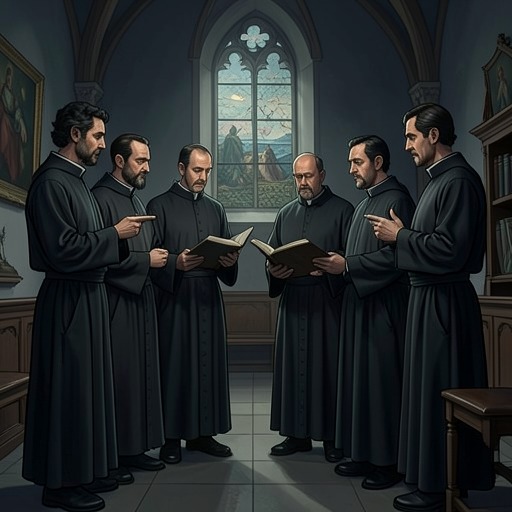
Church doctrine on beasts, devils, and pagans
The Moon and the SunChurch doctrine on beasts, devils, and pagans appears as a hierarchy of categories with sharply different consequences: beasts are available for human use, devils must be resisted, and pagans are targets for conversion. The dispute over the Sea Woman shows that these are not merely labels. The category assigned to an intelligent captive determines whether her words count as evidence, whether she can be treated as a person, and what forms of control may be imposed on her.
The Three Categories and Their Consequences
In Pope Innocent’s formulation, the categories define a religious order of response. Beasts are creatures humans may use; devils are hostile supernatural forces to oppose; pagans are beings who may be brought into the faith. His summary, “God gave us beasts to use, the devil to oppose, and pagans to convert. Which is the monster?”, makes classification the central question. The Sea Woman does not fit comfortably into any category: she is neither presented as an ordinary animal nor accepted by the Church as a human interlocutor, and the possibility that she is demonic remains active in the debate.
The alternatives carry different kinds of power. Pope Innocent demands that the Sea Woman be given to him because she must be studied. If Yves de la Croix is wrong, Pope Innocent argues, she is a demon and must be exorcised; if Yves is right, she is a miracle of creation and must be brought to God and converted from her pagan wildness. The apparent openness of the second possibility is therefore bounded by a predetermined religious end. Even recognition of the Sea Woman as a remarkable creation does not, in Pope Innocent’s argument, establish her right to remain outside Christian authority.
The Sea Woman as a Test of Classification
Marie-Josèphe de la Croix directly challenges the category of monster. She tells the King that she understands the Sea Woman and that the Sea Woman understands her, adding that the captive speaks, is intelligent, and is a woman and human like other people. The claim joins observable communication to a moral assertion of shared personhood. It contests the assumption that an unfamiliar body, or a life outside human society, is sufficient grounds for treating its bearer as less than human.
The King nevertheless uses the word monster when the Sea Woman returns to the surface and breathes. Yves de la Croix dismisses her intelligence by comparing it to a parrot’s, while Marie-Josèphe insists on the significance of speech and understanding. These opposed readings show how easily the same living being can be made to support different classifications: her visible strangeness becomes evidence of monstrosity to one observer, while her communicative capacity becomes evidence of humanity to another.
Evidence, Faith, and the Church’s Authority
The dispute also concerns what counts as proof. Lucien de Barenton, Count de Chrétien, argues that the Sea Woman has already been shown to understand Marie-Josèphe. He recalls that the Church’s treatment of certain beings as demons had changed, and urges the King to allow Marie-Josèphe to test whether the Sea Woman speaks a human language. His appeal to scientific proof makes classification provisional: observation, rather than inherited certainty alone, should decide whether the being can be understood as a person.
Pope Innocent resists the implication that earlier ecclesiastical judgments were mistaken. He maintains that the beings once treated as demonic had been possessed, and that the Inquisition expelled the satanic influence. Later, when Marie-Josèphe’s position is defended, he asks whether she has discussed souls or Christian faith with the Sea Woman, or converted her. The questions set theological tests against the evidence of communication. Marie-Josèphe has demonstrated mutual understanding, but has not established the Sea Woman’s belief or secured her conversion; Pope Innocent treats that absence as a reason to challenge her conclusion.
The Rule’s Limits and Narrative Significance
The category system places the Sea Woman’s fate within a contest between religious authority and inquiry. Marie-Josèphe argues from direct exchange; Lucien asks that her claim be tested; Yves is drawn into the question of whether a being can understand death; and Pope Innocent seeks both jurisdiction over the captive and an outcome shaped by the Church’s categories. The debate does not resolve classification through a neutral definition. Instead, it exposes how the authority to name a being also becomes authority to determine what may be done to her.
The sailors’ later fear of the Sea Woman, nets, guns, and renewed captivity gives the question a material edge: she is not debating her status from a position of safety, but remains vulnerable to human force. The doctrine’s significance lies in this gap between evidence of a mind and the power to recognize it. To call the Sea Woman a beast, demon, or pagan is to prescribe a relation to her; Marie-Josèphe’s insistence that she is a woman challenges the premise that religious and human categories can settle her identity without listening to her.